You can spend real money on a living room and still end up with a space that feels oddly one-note. One of the most common reasons is an overreliance on matching furniture sets: the sofa, loveseat, chair, and tables all repeating the same shapes, finishes, and details.
The result is usually tidy and coordinated-, but it can also feel like the room came as a package-and not in a good way. Today’s design direction leans toward spaces that feel curated: mixed materials, varied silhouettes, and furniture that looks collected over time instead of purchased in one trip. (If you want a concrete example of this approach, see Layered Living Room Leather Furniture.)
In this post, you’ll learn why matching sets can flatten a room, what designers do instead, and a practical, homeowner-friendly way to create depth without turning the space into a visual mess. We’ll also cover where customization (especially in top-grain leather) can help you get that collected look with a more refined finish.
Table of Contents
- Quick Answer: Why Matching Furniture Sets Can Feel Flat
- What Flat Looks Like in a Real Room
- Cohesion vs. Identical: The Key Mindset Shift
- The Collected Formula (What to Repeat, What to Vary)
- How to Mix Pieces Without Visual Chaos
- Mixing Materials (Leather, Wood, Metal, Textiles) on Purpose
- Fixing Flatness With Shape and Scale
- How to Update a Matching Furniture Set-Without Replacing Everything
- Where Customization Makes the Biggest Difference
- A Quick Checklist for a Room That Feels Collected
- Conclusion
Quick Answer: Why Matching Furniture Sets Can Feel Flat
Matching furniture sets can make a room feel flat because they repeat the same visual information across the largest objects in the space. When outlines, finishes, and upholstery all match, your eye has fewer contrasts to notice-so the room reads as one continuous block instead of a layered composition.

In most rooms, that flat feeling comes from a combination of three things:
- Low contrast: the same color value and texture across multiple big surfaces.
- No hierarchy: if everything matches, nothing becomes the focal point.
- Less personality: a set communicates the collection’s style, not necessarily yours.
The fix: keep the room cohesive by repeating a few elements (like tone, proportion, or an accent finish), but purposefully vary silhouettes, textures, and materials so each piece has a role.
If you want a simple rule to remember: match less, coordinate more.
What Flat Looks Like in a Real Room
Flat doesn’t always mean boring-and it doesn’t mean the furniture is poor quality. It usually means the room feels visually heavy, overly uniform, or strangely lifeless even after you’ve cleaned, styled, and added decor.
A room often starts to feel flat when multiple big pieces share all (or most) of these traits:
- Same silhouette: thick arms everywhere, similar back heights, identical base styles.
- Same material everywhere: all smooth leather, or all the same fabric texture.
- Same finish family: tables, legs, and wood tones that blend into one mass.
- No focal hierarchy: everything competes equally-or nothing stands out at all.
Here are a few common symptoms homeowners notice:
- The room photographs fine but feels underwhelming in person.
- You keep buying pillows or accessories, but it still looks incomplete.
- Everything feels the same height and weight from across the room.
- The seating group feels like one large object instead of distinct pieces.
It’s not that the pieces are wrong. It’s that the room lacks contrast, punctuation, and a sense of story. And because furniture sets are made to match perfectly, they remove many of the small variations that create depth.
This is especially helpful in Texas interiors, where many homes mix modern lines with rustic Western character. A statement leather sofa can “make the room,” but only if the surrounding finishes support it (the right rug, the right wood tones, and the right lighting).
Cohesion vs. Identical: The Key Mindset Shift
Here’s the design principle that changes everything:
Cohesion is a relationship between pieces-not a requirement that they be identical.

Matching furniture sets create cohesion by making everything the same. Curated rooms create cohesion by making different pieces feel like they belong together.
Think of it like getting dressed. A matching suit is consistent, but it isn’t your only option. A great outfit can mix a jacket, shirt, denim, and boots-as long as the colors, proportions, and details relate. Rooms work the same way.
To build cohesion without going identical, designers typically lean on a few connectors:
- Color direction: warm neutrals, earth tones, soft grays, deep charcoals.
- Undertones: keeping woods warm with warm, or cool with cool, so finishes don’t fight each other.
- Repeated lines: clean modern frames, gently curved profiles, or more traditional shaping.
- Consistent quality level: mixing is easier when materials and craftsmanship feel equally intentional.
And to be fair, furniture sets are tempting for good reasons. They make shopping feel simple, they remove decision fatigue, and they guarantee no mistakes. The tradeoff is that they can also remove the variety that makes a room feel dimensional.
The Collected Formula (What to Repeat, What to Vary)
If you want a room that looks collected (not showroom-matched), use this approach. It’s structured enough to prevent visual chaos, but flexible enough to feel personal.
Repeat 2 Things
Repeats create calm. They tell your eye, Yes, this is one room. Great options include:
- A color family: warm neutrals, saddle brown, charcoal, or soft creams.
- A vibe: tailored and modern, rustic and textural, refined and transitional.
- A finish cue: a consistent metal finish, a repeated wood undertone, or a shared leather tone.
If you want the easiest repeat for living rooms: choose one dominant upholstery direction (for example, warm brown leather) and let other pieces support it instead of copying it.
Vary 2 Things
Variations add depth. They create the collected over time look. Consider varying:
- Silhouettes: pair a clean-lined sofa with a more open-frame chair (or a gentle curve).
- Textures: mix smooth leather with woven fabric, natural fiber rugs, or matte ceramics.
- Visual weight: balance substantial seating with airier tables or lighter accent pieces.
One practical way to keep variation from feeling random is to plan it in layers:
- Layer 1 (big shapes): sofa/sectional + chairs.
- Layer 2 (hard surfaces): coffee table + end tables + console.
- Layer 3 (soft surfaces): rug + drapery + throws + pillows.
- Layer 4 (finishing): lighting + art + accessories.
When you vary the big shapes and materials first, the room feels dimensional before you add any decor. That’s the difference between a room that feels styled and a room that feels designed.
How to Mix Pieces Without Visual Chaos
Mixing is easiest when you choose an anchor piece and build around it. The anchor keeps decisions grounded, and everything else becomes a response to it.
Step 1: Pick Your Anchor (Usually the Sofa or Sectional)
Start with the largest seating piece because it sets the scale and tone of the room. For many Texas homes, a top-grain leather sofa or sectional is a strong anchor: durable, grounded, and visually rich without needing a loud pattern.
Before you commit, get clear on what the anchor should do. Ask:
- Is this room for everyday lounging, or mostly entertaining?
- Do you want a conversational layout, or a media-focused layout?
- Do you need deep, relaxed seating-or a more upright, tailored sit?
Then decide what you want that anchor to be visually:
- Quiet foundation: clean-lined leather that lets art, lighting, and textiles shine.
- Statement piece: more character in the leather, wood detailing, or Western-inspired craftsmanship.
If you want to go deeper on construction and what separates truly investment-grade seating from mass-manufactured options, see The Anatomy of a Luxury Sofa.
And if you’re furnishing a more open floor plan, this guide can help you think through scale and layout: Best Leather Sofa Set for an Open-Concept Living Room.
Either approach can work. The key is to avoid making every piece the statement and then wondering why the room feels busy-or making every piece identical and then wondering why it feels flat.
Step 2: Add One Contrast Piece
Now you’re layering. A contrast piece breaks the matchy-matchy effect immediately-without requiring a total redesign.
Good contrast choices are usually near neighbors to your anchor. They relate, but they don’t copy. For example:
- If your sofa is smooth leather, try a chair with texture (woven fabric, performance linen, or a nubby neutral).
- If your seating is substantial, choose a more open-base coffee table (metal base, slimmer legs, or a lighter top).
- If your room is all straight lines, add one curve (chair, mirror, or rounded table).
If your space is tighter (or you just want more flexibility), these ideas can help you choose the right profile: Leather Accent Chairs for Small Spaces.
That one move creates a focal point and gives the room a more intentional rhythm.
Step 3: Keep Proportions in the Same Family
This is where many rooms go off track. You can mix styles, but the scale needs to make sense together. Pay attention to:
- Seat heights: chairs and sofas should feel like they belong in the same conversation group.
- Arm thickness: one chunky piece can work; four chunky pieces often feels heavy.
- Leg presence: mixing a skirted sofa with spindly-legged chairs can feel disconnected unless other elements tie them together.
- Table heights: coffee and side tables should serve the seating, not float above it.
A simple homeowner trick: take a photo of the sofa and the chair from the side, then compare back height, seat height, and arm thickness. If one piece looks like it belongs in a different room entirely, it’s usually a proportion issue-not a color issue.
Step 4: Limit the Loud Moves
If you bring in a bold texture, a high-contrast wood finish, and dramatic hardware all at once, the room can feel busy. A refined, collected room usually has one strong move per zone-then supports it with quieter pieces.
Examples of a single loud move:
- A dramatic leather tone (like a rich cognac) paired with calm neutrals elsewhere.
- A statement chair silhouette with simpler tables and lighting.
- A bold rug that introduces pattern while the upholstery stays solid.
One reason leather works so well as an anchor in a collected room is that it develops more character over time. If you’re curious what that looks like in real homes, read Why Leather Sofas Look Better With Age.
When you limit strong moves, the room stays readable. That readability is what makes a space feel expensive even when the design is simple.
Mixing Materials (Leather, Wood, Metal, Textiles) on Purpose
Material mixing is one of the fastest ways to add depth-especially when you’re trying to move beyond matching furniture sets. The goal isn’t to add as many materials as possible. The goal is to add the right contrast in the right places.
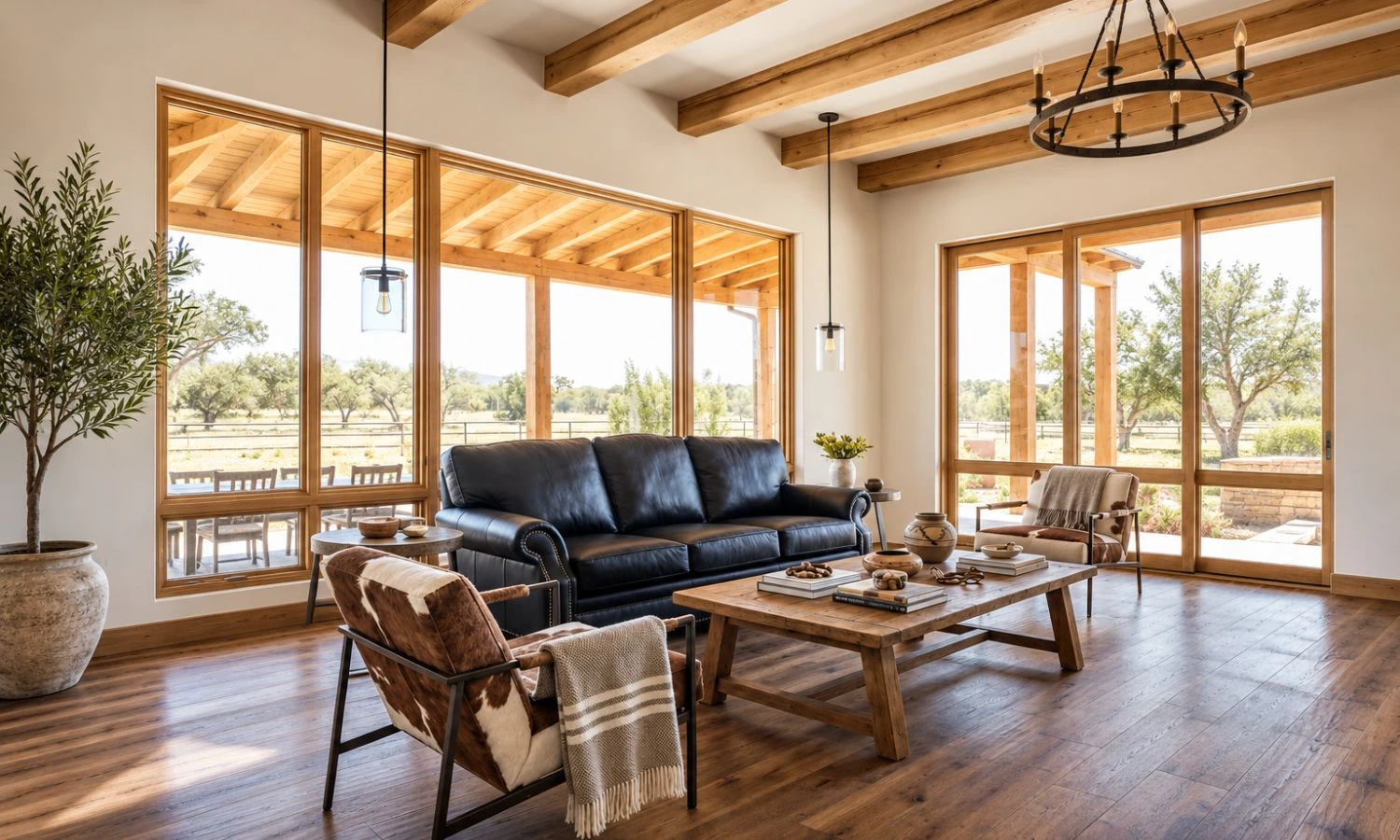
Leather + Textile: Balance Polish With Softness
Leather brings structure and richness. Textiles bring softness and a more lived-in, layered feel. A common designer approach is leather main seating + textile accent seating (or vice versa), tied together with a rug and a few repeating tones.
To keep this looking refined (not mismatched), choose your textile based on what the leather needs:
- If the leather is dark: consider lighter textiles to lift the room.
- If the leather is warm: choose textiles with warm undertones (cream, oatmeal, camel, warm gray).
- If the leather has a lot of character: keep textiles quieter so the leather remains the focal point.
If you’re deciding between different leather looks (smooth vs. more visible grain, matte vs. more sheen), this can help: Leather Furniture Texture and Grain Guide.
And don’t forget comfort. A room feels luxurious when it’s inviting to use, not just nice to look at.
Wood Finishes: Don’t Chase Perfect Match
Exact wood matches are harder than they look, especially across different manufacturers. Almost matching finishes can actually look like a mistake because they feel accidental.
Instead:
- Choose one dominant wood tone for larger pieces (like a console or cocktail table).
- Add a second tone that’s clearly different (lighter, darker, or more rustic) so it feels intentional.
- Focus on undertones (warm vs. cool) and overall character (refined vs. weathered).
This is especially useful in Texas interiors where you may already have strong fixed elements-wood floors, ceiling beams, stone fireplaces, or iron accents. Those built-ins count as part of your finish palette.
Metal and Stone: Use Them as Relief
When a room is heavy with upholstery and wood, metal or stone can act like visual breathing room. A slim metal base, a lighter stone top, or a mixed-material table can add contrast without adding another bulky shape.
Two practical guidelines:
- Repeat metal finishes at least twice. For example, black iron on a table base + picture frame + lighting detail.
- Use stone where you want light and clarity. It can brighten a seating group that otherwise reads as all brown or all dark.
Fixing Flatness With Shape and Scale
Even with varied finishes, a room can still feel flat if all the big pieces share the same silhouette. Shapes create movement. When everything is the same shape, your eye stops traveling-and the room feels static.
Do a quick outline check by standing at the main entry to the room and looking at the seating group as a single composition. Then ask:
- Too many rectangles? Add one curve (chair, ottoman, mirror, or round table).
- Everything low and wide? Add height with a taller cabinet, bookcase, or statement floor lamp.
- Is everything visually heavy? Swap in one open-frame piece (chair, console, or table base).
Scale matters just as much as shape. Rooms feel off when furniture is too large for the floor plan-or when pieces are undersized and float away from each other. A few checks that help:
- Rug scale: in most living rooms, the front legs of seating should sit on the rug.
- Table reach: side tables should be close enough to actually use from the seat.
- Walking paths: maintain clear circulation so the room feels comfortable to move through.
Often, one silhouette change does more than a dozen new accessories. If the room feels flat, look at the big outlines first-then decorate.
How to Update a Matching Set-Without Replacing Everything
If you already own a matching set, you’re not stuck with a flat room. You can de-set it in phases, and you can do it in a way that respects what you already own.
Phase 1: Rearrange Before You Replace
Before you buy anything, experiment. Try:
- Separating matching chairs so they aren’t a pair in the same sightline.
- Moving the loveseat to a different room (or removing it temporarily) to reduce visual bulk.
- Changing the angle of a chair to create a more dynamic layout.
Sometimes the flatness is really a layout issue-and you can fix it for free.
Phase 2: Replace One Thing That Creates Contrast
When you’re ready to make a change, start with a piece that will have a big visual payoff:
- Replace one matching chair with a contrasting accent chair.
- Swap the matching table group for one mixed-material coffee table.
- Change one large texture (a rug is often the easiest) to introduce pattern and dimension.
The goal isn’t to make everything different. It’s to introduce enough variation that the room feels layered and personal.
Phase 3: Upgrade With Intention, Not Urgency
A collected room is built over time. If you replace everything at once, you can accidentally recreate the same set effect-even if the pieces don’t technically match. Make one strong decision, live with it, then choose the next piece based on what the room still needs.
Where Customization Makes the Biggest Difference
This is where a high-end retailer can be a real advantage. Instead of accepting a pre-determined set, you can create cohesion through intentional choices-without forcing every piece to match.
At Texas Leather Interiors, many collections are available with options that help you build a curated room. If you want a starting point for pieces designed around that mix-and-match approach, explore the Texas Leather Collection:
- Top-grain leather choices that change the tone from modern and tailored to warm and rustic.
- Configuration flexibility for sectionals and seating arrangements that fit real floor plans.
- Finish and detail decisions (wood tones, textures, and accents) that create a more personal result.
Customization works best when it solves a specific problem: scale, layout, comfort, or the need to complement finishes you’re already keeping. Instead of thinking, What set should I buy? a better question is:
What does my room need the furniture to do-and how do I want it to feel?
If you’re working with a design expert, come prepared with:
- Room measurements (including wall lengths and walkways).
- Photos from multiple angles (daylight and evening if possible).
- Notes on what stays (floors, rugs, existing art, or inherited pieces).
- How you actually use the room (TV, conversation, entertaining, reading).
That information makes it much easier to build a cohesive plan with mixed pieces-and avoid defaulting back to matching furniture sets.
A Quick Checklist for a Room That Feels Collected
Use this checklist as a quick audit when you’re shopping, rearranging, or planning a refresh.
- Anchor piece chosen: sofa/sectional sets the tone and scale.
- 2 repeats: color family, vibe, and one finish/detail cue.
- 2 variations: silhouette, texture, and visual weight.
- One contrast move per zone: don’t introduce five bold changes at once.
- Proportions align: seating heights and table heights work together.
- Wood tones intentional: one dominant + one clearly different (not almost-matching).
- Layout works in real life: walking paths are clear, tables are within reach, lighting serves the seats.
If you check most of these boxes, your room will almost always look more curated-even with simple decor.
Conclusion
Matching furniture sets can feel flat because they remove contrast-one of the key ingredients that makes a room feel designed, lived-in, and personal. The alternative isn’t disorder. It’s a more curated approach: repeat a few elements for cohesion, then vary silhouettes, textures, and materials so the space feels collected over time.
Ready to build a room with more depth (and a better fit for the way you live)? Request a free design consultation at our San Antonio or Austin showroom.